Case study
Clinical App for Home Rehabilitation
An application designed around professional practice to support everyday home physiotherapy, with clinical data modelled using FHIR.
In development and evaluation · No public demo
An app designed around everyday practice
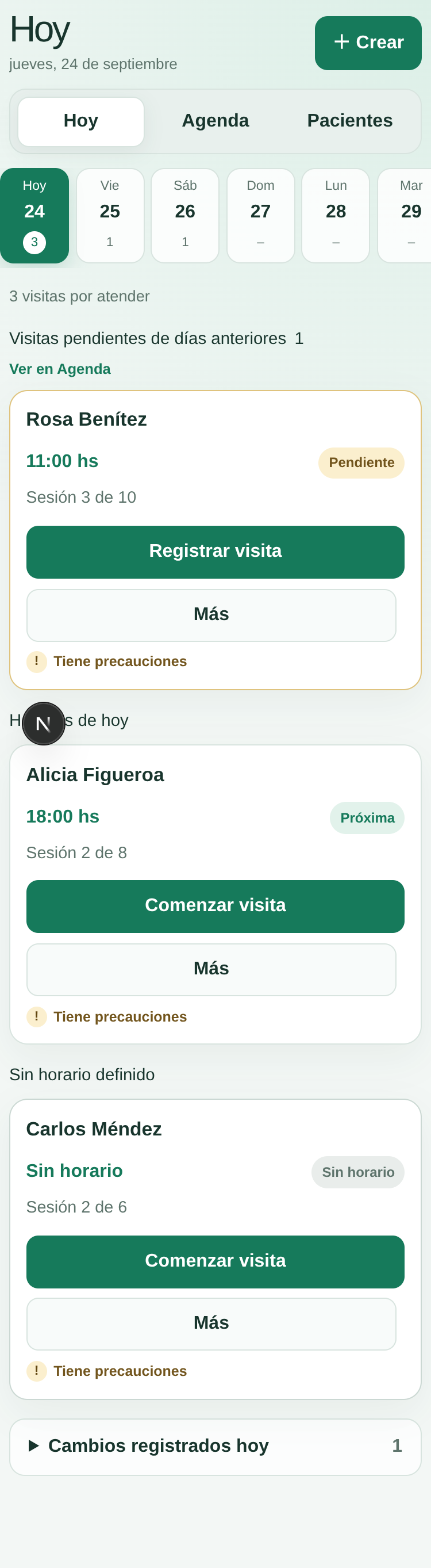
The application aims to make an independent home physiotherapy professional’s work easier. Its design starts with understanding how care happens in practice: from the initial enquiry and coordinating visits through to record-keeping, follow-up, and reports.
Better records, with less effort
Current work focuses on aligning the flows with that reality and identifying which parts of the forms can be simplified. The priority is clear, useful information for continuing care, with a clear field hierarchy and validation that supports good record-keeping practices.
Corrections and annulments retain their reasons. Reports can be reviewed before saving and downloaded as PDFs; replacements preserve a history.

Building on existing standards
Clinical data is modelled using FHIR to build on an established structure and avoid creating a custom model where the standard already meets the need. The clinical model is kept separate from the screens so the experience can be adapted to the professional.
Interoperability is a design goal; there are no integrations with other systems yet.
Access and privacy by design
The application implements passkey access, per-device sessions, and revocation and recovery mechanisms. Validation with an independent authenticator and of the complete recovery flow remains pending.
Design and deployment decisions take Argentina’s Law 25.326 on Personal Data Protection and Law 26.529 on Patient Rights, Clinical Records, and Informed Consent as references, considering confidentiality, authorised access, and safeguarding clinical information.
Current status and evolution
The application requires a connection. Offline work and draft backup are planned areas of development.
In the medium term, AI assistance is planned to help draft reports from the available clinical records. The proposal is to generate drafts for the professional to review, correct, and validate before issuing them, taking data privacy into account and without introducing information unsupported by the records.
Public screenshots use fictional data only. The application has no public demo.